


When Tanya and Craig Collins began building an investment property in Whyalla, the expected construction period was about six months. Then their bricklayer unexpectedly passed away.
In a regional market with few available trades, the project could not simply move to the next contractor. A replacement had to be brought in from Port Augusta, extending the build by another six to nine months. The delay cost the couple time and additional interest, even though the property was already approved and underway.
Their experience is a small but revealing example of the constraint at the centre of Australia’s housing crisis. Governments can release land, accelerate planning and announce approval targets. None of those measures produces a home until somebody can finance, build and complete it.
An approval is not a home
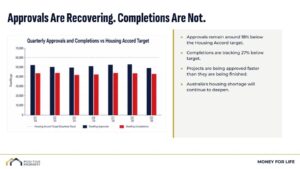
The National Housing Accord calls for 1.2 million homes to be delivered over five years to June 2029. That requires an average of 240,000 completed dwellings each year.
Approvals have recently improved. In the year to June 2026, more than 205,000 dwellings were approved, the strongest annual result since 2020–21. It is encouraging, but approvals measure intention rather than finished supply.
The completion figures tell a more difficult story. Australian Bureau of Statistics data shows 43,816 dwellings were completed in the March 2026 quarter. That equates to roughly 174,000 homes over a year if the same pace is maintained, leaving a sizeable gap against the Accord’s required rate.
At the same time, 243,864 dwellings remained under construction, the highest number recorded since the series began in 1984. Australia is not short of projects in the pipeline. It is struggling to move them through it.
Why Australia’s housing crisis persists
The causes are less visible than a planning announcement. Builders must contend with shortages of skilled workers, elevated material costs, tighter margins and expensive development finance. For apartment projects, feasibility can change significantly between approval and commencement. For regional builds, the absence of a single trade can delay an entire schedule.
This is why treating faster approvals as the solution risks mistaking paperwork for production. Planning reform matters, but it cannot replace construction capacity.
The National Housing Supply and Affordability Council estimated that around 980,000 homes would be completed during the Accord period, approximately 220,000 fewer than the national target. That deficit would continue placing pressure on rents, vacancy rates and prices, particularly in markets where population growth is concentrated.
What investors should watch
For property investors, the more meaningful measure is not how many dwellings enter the pipeline, but how many leave it.
Completions reveal whether supply is genuinely reaching the market. Construction backlogs show where labour and financing constraints are slowing delivery. Local vacancy rates help establish whether new housing is keeping pace with demand.
Tanya and Craig ultimately completed their Whyalla property and secured rent around $40 a week above their initial expectation. The result does not erase the difficult build. It demonstrates the patience required when a national shortage collides with local construction capacity.
Australia’s housing crisis will not be resolved through approvals alone. Until completed homes begin rising at the pace of demand, the shortage remains real.
_
P.S. Whenever you’re ready… here are 4 ways Positive Property can help you create money for life through property:
-
Grab The Freedom Through Property Book: The roadmap 3,500+ Australians have used to start building wealth through property. [Get your free copy]
-
Watch the Positive Property Show: Livestreamed every Thursday with real market data, member wins, and the strategies behind them. [Watch on YouTube]
-
Join 9,000+ Australian Property Investors: Positive Property Investors Australia, our Facebook community of smart investors sharing tips, wins, and strategies. [Join the group]
-
Watch Our Free Training: The exact strategy our members use to build portfolios of 5-10 properties and create money for life. [Watch the free training]